Hooked on Anger: Why ‘Rage Bait’ Is 2025’s Word of the Year (And How to Escape It)
【この記事にはPRを含む場合があります】

Have you ever scrolled through your feed and stopped dead at a post that made you think, “This is absolutely ridiculous!” or “How can anyone be this stupid?” Before you know it, you’re typing a furious comment or quote-tweeting it to your followers to show just how wrong it is.
If this sounds familiar, you haven’t just stumbled upon bad content—you’ve likely swallowed the hook of a psychological trap known as “Rage Baiting.”
That flash of irritation isn’t accidental. It is a manufactured product designed to hijack your emotions for profit. In an era where attention is currency, making you mad is the quickest way to get paid. Here is a deep dive into what rage baiting is, why it was chosen as the Oxford Word of the Year 2025, and how you can outsmart the algorithms trying to manipulate you.

- What is Rage Baiting?
- The Science of Fury: Why We Always Take the Bait
- Spotting the Trap: Common Types of Rage Bait
- The "Deliberate Error" Strategy
- The "Entitled Character" (The Performer)
- Political "Spin" and Distraction
- How to Protect Your Peace: 4 Defense Strategies
- 1. Starve the Trolls (The Nuclear Option)
- 2. The 5-Second Rule
- 3. Practice "Lateral Reading"
- 4. Touch Grass (Digital Detox)
- Take Back Control
What is Rage Baiting?
(And Why Is Everyone Talking About It?)
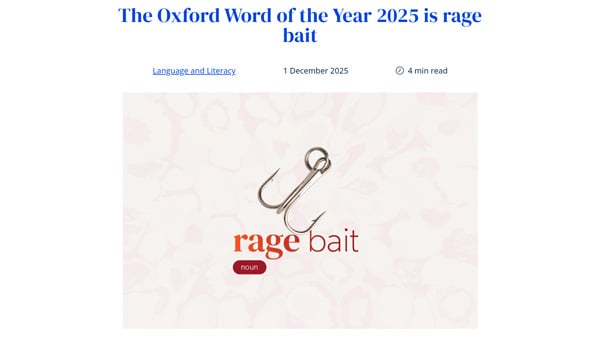
(Source: Oxford University Press)
Rage Baiting (or simply “rage bait”) refers to the manipulative tactic of posting content specifically designed to provoke outrage, aiming to maximize traffic, engagement, and revenue.
The term is a portmanteau of “Rage” and “Bait” (as in fishing). While the concept has roots in early internet culture—dating back to Usenet trolls in 2002—it has evolved from simple pranksterism into a sophisticated, algorithmic business model.
Its impact on our digital lives has become so undeniable that Oxford University Press (OUP) selected “Rage Bait” as the Word of the Year for 2025.
From Curiosity to Emotional Hijacking
According to OUP experts, the digital landscape has shifted. We have moved past the era of “Clickbait,” which relied on curiosity gaps (“You won’t believe what happened next!”). We have now entered a darker phase where content creators and platforms hijack our raw emotions to manipulate our behavior.
This ecosystem has even spawned new terms like “Rage-farming” and “Rage-seeding.” These metaphors describe the calculated process of planting seeds of anger to harvest engagement from a polarized audience—often used to amplify political messages or boost influencer clout. Unlike the chaotic “trolls” of the past who did it for laughs, modern rage baiting is often organized, strategic, and financially motivated.

The Science of Fury: Why We Always Take the Bait
Why is it so hard to just scroll past a bad take? The answer lies in a toxic mix of evolutionary biology and sophisticated algorithms.
1. The Negativity Bias
Humans are hardwired with a “negativity bias.” Our brains are programmed to react more strongly to negative information than positive news—a survival mechanism that once helped us avoid predators. Research suggests we need about five positive events to counteract the psychological impact of just one negative event.
Just as we can’t help but stare at a fight breaking out at a party, we are biologically compelled to pay attention to conflict online.
2. Anger Makes Us “Stupid”
The most insidious aspect of rage bait is how it affects cognitive function. Intense anger stimulates the brain’s emotional centers while actively inhibiting the areas responsible for critical thinking and logic.
When you are enraged, you feel powerful or righteous, but your ability to spot contradictions or risks drops effectively. In short: if you are raging, you aren’t thinking. This makes you an easy mark for manipulation.
3. Algorithms That Turn Anger into Cash
Your outrage is delicious food for social media algorithms. Platforms like X (formerly Twitter), TikTok, Instagram, and YouTube prioritize high-engagement content.
The irony is cruel: when you quote-post a terrible take to dunk on it, or leave an angry comment, you are signaling to the algorithm that this content is valuable.
- Viral Power: Posts triggering anger can have 20% higher spreadability.
- Reaction Weighting: Historically, platforms have heavily weighted emotional reactions (like the “Angry” face) over simple likes, boosting visibility even further.
Your anger is literally being converted into someone else’s ad revenue.

Spotting the Trap: Common Types of Rage Bait

Rage bait isn’t always obvious. It wears many masks. Here are three common archetypes you’ll find in the US market:
The “Deliberate Error” Strategy
Creators will intentionally do something incorrect to bait you into the comments section to “correct” them.
- Food Crimes: Eating pizza with a spoon, or the eternal “pineapple on pizza” debate.
- Wild Takes: Statements like “Children should be taxed” or purposely mispronouncing common words. They want you to correct them. Every correction boosts their video in the algorithm.
The “Entitled Character” (The Performer)
Many influencers play a character designed to be hated—think of the “Main Character” syndrome or the “Karen” archetype.
- The Snob: A model complaining about “poor service” while being rude to staff.
- Wasteful Consumption: Videos of people destroying expensive makeup or wasting massive amounts of food. Viewers watch to feel morally superior, not realizing the creator is following a script to farm that exact reaction.
Political “Spin” and Distraction
In the political sphere, rage bait is used as a smokescreen (often called “the dead cat strategy”). A sensational, infuriating story is released to dominate the news cycle, distracting the public from unpopular legislation or scandals passing quietly in the background.

How to Protect Your Peace: 4 Defense Strategies

You don’t have to be a pawn in the engagement economy. Here is how to reclaim your attention.
1. Starve the Trolls (The Nuclear Option)
The creator wants your reaction. Deny them.
- Don’t Comment, Don’t Share: Even a hate-share is a win for them.
- Block and Mute: Curate your feed aggressively. If a creator consistently annoys you, remove them from your digital world. Indifference is the only thing that kills rage bait.
2. The 5-Second Rule
When you feel that spike of adrenaline, stop. Do not type.
- Ask yourself: “Is this designed to make me mad?”
- Wait 5 seconds. Anger peaks quickly. Give your rational brain a moment to come back online before you react.
3. Practice “Lateral Reading”
If you see a shocking headline or a radical claim, don’t just read the post. Open a new tab and check if other reputable sources are reporting it. This technique, known as lateral reading, helps verify if the “outrage” is real or manufactured.
4. Touch Grass (Digital Detox)
Remember that the internet is not real life. If you feel the “doomscroll” taking over, put the phone down. Reconnecting with the physical world resets your baseline and reminds you that most people aren’t trying to fight you.
Take Back Control
Rage bait is a tool used to divide us and monetize our stress. But now that you know how the trick works, you don’t have to fall for it.
Next time you see a post designed to make your blood boil, take a breath. Scroll past it. By refusing to engage, you aren’t just protecting your mental health—you’re helping to make the internet a little less toxic, one skipped post at a time.

- Can Former PlayStation Engineers Dethrone NVIDIA? Meet the Japanese AI Chip Slashing Power Use by 90%
- Rapidus Explained: Japan’s Bold $35B Bet on 2nm Chips to Rival TSMC