Rapidus Explained: Japan’s Bold $35B Bet on 2nm Chips to Rival TSMC
Hokkaido / Japan / Semiconductor
【この記事にはPRを含む場合があります】
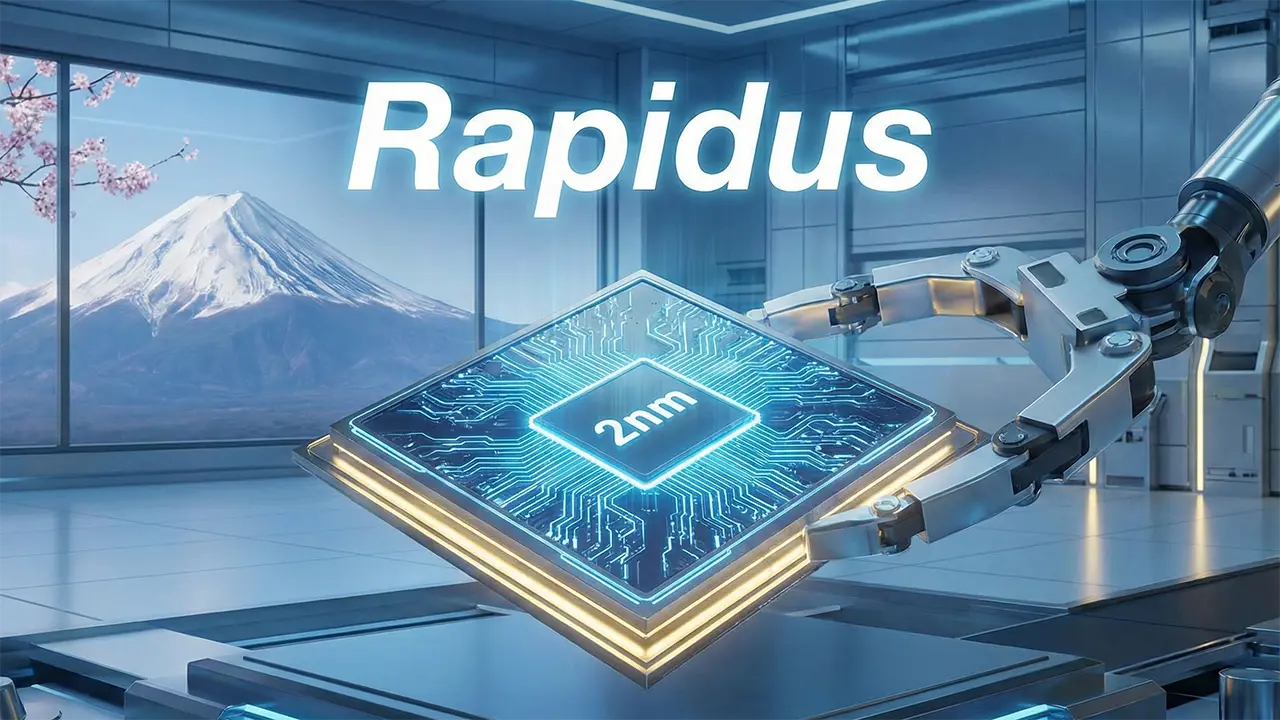
“What exactly is Rapidus?” “I know semiconductors are important, but can Japan really make a comeback in the global tech race now?” “How does this affect the supply chain—and my stock portfolio?”
If you’ve been following global tech news, you might have asked these questions.
Right now, in the northern city of Chitose, Hokkaido, a massive project is underway that could determine the future of Japan’s economy. The company is Rapidus, a state-backed venture aiming to domesticate next-generation semiconductor manufacturing.
Think of it as Japan’s “Avengers” of tech. Backed by industry titans like Toyota, NTT, and Sony, and supported by roughly 5 trillion yen (approx. $33–35 billion USD) in government funding, this is a national strategic project of the highest order.
If successful, Japan will secure the “heart” of future AI and autonomous driving technologies, creating a massive economic impact. However, critics argue it’s a reckless gamble, questioning whether pouring billions into a “moonshot” project can really pay off.
In this article, we break down what Rapidus is building, how it differs from TSMC, its strategy for success, and the risks involved—all in plain English.

- What is Rapidus? The "All-Japan" Team Aiming for the Top
- An "All-Japan" National Project
- The Target: "2-Nanometer" Logic Chips
- Why Hokkaido? The "Silicon Valley of the North"
- How Will Rapidus Fight? Strategy vs. The Giants
- Is Success Realistic? The Odds and The Risks
- How to Invest? (Stock Market Insight)
- Rapidus vs. TSMC: The Cheat Sheet
- The Bottom Line
What is Rapidus? The “All-Japan” Team Aiming for the Top
(Source: Rapidus Corporation)
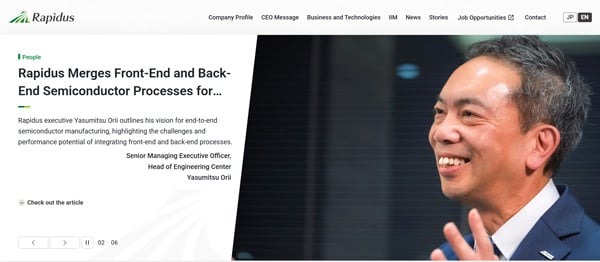
Rapidus Corporation was established in August 2022. The name comes from the Latin word for “quick,” signaling that speed is their primary weapon.
An “All-Japan” National Project
Rapidus isn’t just another startup. Its credibility comes from its shareholder list, a “Who’s Who” of Japan’s corporate heavyweights. At its founding, eight major companies invested:
- Toyota (Automotive)
- Sony Group (Entertainment & Tech)
- NTT (Telecom)
- SoftBank (Tech Investment)
- NEC (IT/Network)
- Denso (Auto Components)
- Kioxia (Memory)
- MUFG Bank (Finance)
With the Japanese government committing trillions of yen in support, this is truly an “All-Japan” effort to reclaim semiconductor sovereignty.
The Target: “2-Nanometer” Logic Chips
Rapidus is skipping intermediate steps and aiming directly for the summit: 2-nanometer (nm) logic semiconductors.
To put that in perspective, “nano” refers to the circuit line width. 2nm is tens of thousands of times thinner than a human hair. Currently, only the global “Big Three”—TSMC (Taiwan), Samsung (Korea), and Intel (USA)—have the technology to mass-produce at this level.
While Japan has been considered “lapped” in the semiconductor race (currently stuck at the 40nm generation), Rapidus aims to close that gap instantly and leapfrog to the world’s cutting edge.
Why Hokkaido? The “Silicon Valley of the North”
The manufacturing hub, dubbed IIM (Innovative Integration for Manufacturing), is being built in Chitose, Hokkaido. The location was chosen for its vast land, abundant clean water (crucial for chipmaking), and proximity to New Chitose Airport, facilitating global logistics. The vision is to create a “Hokkaido Valley” that integrates R&D and manufacturing.

How Will Rapidus Fight? Strategy vs. The Giants

You might wonder: “With TSMC and Samsung dominating, can a new player really win?” Rapidus isn’t trying to beat them at their own game. They aren’t aiming for massive volume.
1. The “Boutique Kitchen” Strategy
Existing giants like TSMC operate like a massive supermarket, excelling at high-volume mass production. Rapidus, conversely, aims to be a high-end restaurant kitchen: producing specialized, custom-made chips at breakneck speeds.
As AI and autonomous driving evolve, the market is shifting from “general-purpose” chips to “specialized AI chips.” Rapidus plans to cut the Turnaround Time (TAT)—the time from design to delivery—by more than half.
They are achieving this through:
- Single-Wafer Processing: Instead of the traditional “batch processing” (handling many wafers at once), Rapidus processes wafers one by one. Using AI to analyze data in real-time allows for higher speed and quality control.
- AI-Assisted Design: Utilizing “Raads” design support AI to drastically shorten development cycles.
2. Looking Beyond 2nm to 1.4nm
While targeting 2nm mass production by 2027, Rapidus is already eyeing the 1.4nm generation. They are collaborating with America’s IBM and the Belgian research hub imec, sending engineers to New York to absorb top-tier know-how.
3. Innovation in the “Back-End”
Rapidus is also revolutionizing the “back-end” process (packaging chips). A key focus is glass substrates. Unlike traditional plastic, glass is flatter and more heat-resistant, making it ideal for high-performance AI chips. Their announcement of a 600mm square glass substrate technology has already caught the attention of major players like NVIDIA.

Is Success Realistic? The Odds and The Risks
This is a $35 billion project. Is it a “mission impossible”?
Reasons for Optimism
- Tech Validation: Jim Keller, the legendary chip architect (CEO of Tenstorrent), has praised Rapidus’s prototype data as “very good”.
- Geopolitical Insurance: With most advanced chips coming from Taiwan (TSMC), the world worries about geopolitical risks. A supply base in Japan serves as crucial “insurance” for global companies.
- Explosive AI Demand: The AI boom is causing chip and power shortages. The demand for energy-efficient, advanced chips is predicted to skyrocket.
Potential Risks
- Massive Costs: Construction and equipment costs are astronomical. If they can’t secure enough customers, the factory could become a money pit.
- The “Valley of Death”: Moving from a prototype to stable mass production is notoriously difficult. Even Samsung and Intel struggle with yield rates for cutting-edge chips.
- Past Failures: Japan has a history of struggling with state-led chip projects (like Elpida Memory). Skeptics worry history might repeat itself.
How to Invest? (Stock Market Insight)

For US investors looking to ride this wave, there is a catch: Rapidus is currently not a publicly traded company, so you cannot buy its stock directly.
However, you can look at related stocks and supply chain partners:
- Investors: Toyota (TM), Sony (SONY), NTT (NTTYY).
- Equipment & Materials:
- Tokyo Electron (TOELY): Japan’s largest chip equipment maker.
- Lasertec (LSRCY): Holds a monopoly on essential inspection equipment for extreme ultraviolet (EUV) lithography.
- Ajinomoto (AJINY): Surprisingly, the food company holds a near 100% share in a specialized insulation film used in high-performance CPUs.
(Note: Tickers listed are for reference (ADRs). Always do your own due diligence.)

Rapidus vs. TSMC: The Cheat Sheet

Here is how the Japanese challenger compares to the Taiwanese giant:
| Feature | TSMC (Taiwan) | Rapidus (Japan) |
|---|---|---|
| Position | World’s Largest Foundry | Next-Gen Speed Foundry |
| Specialty | Mass Production (iPhone chips, etc.) | High-Mix, Low-Volume (AI, Custom) |
| Process | Batch (Group processing) | Single-Wafer (One-by-one high speed) |
| Target | Apple, NVIDIA (Huge orders) | Startups, Specialized AI Chips |
| Key Strength | Massive Capacity & Track Record | Speed (Time-to-Market) |
Rapidus isn’t trying to kill TSMC; it wants to dominate the niche that TSMC is too big to serve efficiently: speed and customization.
The Bottom Line
Rapidus represents Japan’s last chance to regain its status as a semiconductor superpower.
With mass production slated for 2027, the clock is ticking. Whether this bold, taxpayer-funded bet results in a triumph of innovation or a costly lesson remains to be seen. But in a world hungry for AI chips and supply chain diversity, Rapidus is a name you’ll want to remember.

- Hooked on Anger: Why 'Rage Bait' Is 2025's Word of the Year (And How to Escape It)
- Warning: Fake 7-Zip Sites Are Topping Search Results – How to Spot the Real Deal and Stay Safe