Is 3I/ATLAS an Alien Spaceship? Separating Viral Rumors from NASA Facts
【この記事にはPRを含む場合があります】

Have you noticed the name 3I/ATLAS trending on social media lately? From TikTok to X (formerly Twitter), the internet is buzzing with unsettling rumors: “Is it an alien spaceship?” “Is it spreading an unknown virus?” or even “Is it on a collision course with Earth?”.
Discovered in July 2025, this mysterious visitor has sparked debates among astronomy enthusiasts and conspiracy theorists alike, drawing comparisons to previous interstellar visitors like ‘Oumuamua and Comet Borisov. With its strange behavior and unique characteristics, it’s natural to feel a bit anxious. Some are even whispering that NASA might be hiding the truth.
So, what is really going on? In this article, we’ll break down exactly what 3I/ATLAS is, explore why people are convinced it’s an extraterrestrial craft, and reveal the truth based on the latest data from NASA.

- Why the "Alien Spaceship" Theory Went Viral
- 1. Driving the Wrong Way Down a One-Way Street?
- 2. The Mysterious "Heartbeat" Signal
- 3. The "Manhattan-Sized" Mothership Rumor
- 4. The "NASA Cover-Up" Conspiracy
- NASA Reveals the Truth: Science vs. Fiction
- It’s an Active Comet, Not a Metal Ship
- The "Signal" Was Just Physics
- It’s Smaller Than We Thought
- No Viruses, No Impact
- Why Is It Green?
- A Once-in-a-Lifetime Cosmic Event
- How to See It (December 2025)
Why the “Alien Spaceship” Theory Went Viral

To understand the panic, we first need to look at the object itself. 3I/ATLAS (officially C/2025 N1) was detected on July 1, 2025, by the ATLAS telescope system in Chile. It is the third interstellar object ever observed—meaning it came from outside our solar system—hence the designation “3I“.
While it might look like a comet, several “abnormal” features fueled the speculation that it could be artificial.
1. Driving the Wrong Way Down a One-Way Street?
Most comets enter our solar system from random angles. However, 3I/ATLAS entered on nearly the exact same plane as Earth and Mars (the ecliptic plane) but is moving in the opposite direction (retrograde orbit) at a 175-degree inclination.
It’s like a car driving perfectly in a lane but against traffic. Harvard astrophysicist Avi Loeb pointed out that the probability of an object naturally aligning this perfectly with our planetary plane is extremely low, suggesting it could be “intentionally controlled”. This fueled the theory that someone—or something—is piloting it.
2. The Mysterious “Heartbeat” Signal
The internet went wild over reports of a light signal blinking every 16.16 hours. Many jumped to the conclusion that this was an “alien heartbeat” or a communication signal. Additionally, the object showed non-gravitational acceleration—it was speeding up in a way that the sun’s gravity couldn’t explain, leading some to believe it had an engine.
3. The “Manhattan-Sized” Mothership Rumor

Initial estimates suggested the core was over 12 miles (20km) wide—roughly the size of Manhattan. This would make it massively larger than previous visitors like ‘Oumuamua. The idea of a city-sized object speeding through our solar system was enough to convince many that it must be a mothership.
4. The “NASA Cover-Up” Conspiracy
To make matters worse, a U.S. government shutdown in October 2025 halted updates to NASA’s website just as 3I/ATLAS was closest to Mars. The lack of immediate photos led to wild speculation that NASA had photographed something “dangerous” and was scrambling to cover it up.

NASA Reveals the Truth: Science vs. Fiction

If you’re worried that we’re about to be invaded, you can relax. Subsequent observations using the James Webb Space Telescope (JWST) and Hubble have provided scientific explanations for all these mysteries.
It’s an Active Comet, Not a Metal Ship
The JWST confirmed that 3I/ATLAS is an “active comet” spewing ice and dust, not a metallic alien structure. Analysis shows it is rich in carbon dioxide (CO2) ice, with traces of water and carbon monoxide—standard ingredients for a comet.
The “Signal” Was Just Physics
The “16-hour signal” wasn’t a message from E.T.; it was simply the comet’s rotation period. Because the comet is irregularly shaped, its brightness fluctuates as it spins every 16 hours, reflecting sunlight differently.
It’s Smaller Than We Thought
That “Manhattan-sized” rumor? High-definition analysis from Hubble revealed the actual core is likely less than 0.6 miles (under 1km) in diameter. The initial size estimates were thrown off by the massive cloud of gas and dust (the coma) surrounding the tiny core. It’s actually quite small compared to other celestial bodies.
No Viruses, No Impact
Rumors about the comet spreading “space viruses” have zero scientific basis. While comets do contain chemicals like cyanide, they are in such low concentrations in space that they pose no threat to Earth’s atmosphere.
Most importantly, 3I/ATLAS will not hit Earth. Its closest approach will be around December 19, 2025, at a distance of 1.8 Astronomical Units (AU)—that’s about 167 million miles away. It will pass far beyond the orbit of Mars, posing absolutely no physical danger to us.
Why Is It Green?
Some observers noted the object glowing green or golden, calling it “eerie.” This is a natural chemical reaction. Carbon and cyanogen in the comet glow green when hit by sunlight, while heavy dust reflection can make it appear golden. It’s chemistry, not alien technology.

A Once-in-a-Lifetime Cosmic Event
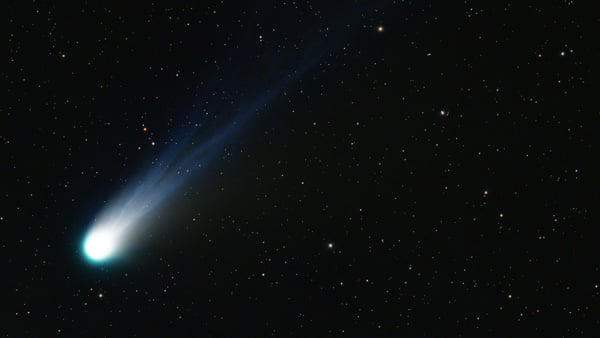
Now that we know it’s not a threat, we can appreciate 3I/ATLAS for what it really is: a rare traveler from deep space that we will never see again.
How to See It (December 2025)
Currently moving through the constellations Virgo and Leo, the comet is offering a viewing opportunity leading up to its closest approach in mid-December 2025.
- Can I see it with the naked eye? Unfortunately, no. With a magnitude of roughly 12, it is too faint.
- Best way to view: You will need a powerful telescope or a smart telescope (like an Unistellar eVscope or Seestar) to capture it. In photos, it will appear as a fuzzy green or white dot, possibly with a faint tail.
If you don’t have a telescope, search for hashtags like #3IATLAS or #C2025N1 on social media to see images captured by astronomers around the world.
While it may not be the alien mothership the internet feared, the reality is still poetic. We are witnessing a genuine interstellar object that has traveled for millions of years to briefly wave goodbye to our solar system. So, look up at the winter sky and take a moment to marvel at the vastness of our universe.

- ChatGPT’s “Code Red” Update: GPT-5.2 Release Date, Pricing, and Gemini 3 Comparison
- Is Gemini 3 Flash Free? Speed, Pricing, and How It Beats GPT-5.2 & Gemini 3 Pro