


ChatGPT’s “Code Red” Update: GPT-5.2 Release Date, Pricing, and Gemini 3 Comparison
[This article may contain PR]

OpenAI’s evolution isn’t slowing down. But what actually makes GPT-5.2 so special? Is it smarter than Google’s Gemini? And what does it cost?
On December 11, 2025, OpenAI dropped a bombshell on the tech world with the surprise release of its latest model, GPT-5.2.
Rumors are swirling that this wasn’t a standard scheduled update. Insiders suggest this was a “Code Red” release—an emergency deployment pushed forward to counter the rapid ascent of Google’s Gemini 3. The goal? To reclaim the AI throne immediately.
With speculation that this AI is capable of replacing human experts, we need to separate the hype from reality. Here is everything you need to know about what’s new in GPT-5.2, how it compares to Gemini, and current pricing.
- When Can You Use GPT-5.2? Release Date and Pricing
- GPT-5.2 vs. 5.1: 5 Key Features That Change the Game
- 1. "Thinking" Ability Surpasses Human Experts
- 2. A Perfect Score in Math & Coding
- 3. "Vision" Upgrade: It Sees Details You Miss
- 4. Massive Context Window (400k Tokens)
- 5. Fewer Hallucinations
- The Showdown: GPT-5.2 vs. Google Gemini 3
- Verdict: We Are Entering "Emergency" Speeds of Evolution
When Can You Use GPT-5.2? Release Date and Pricing
(Source: OpenAI)
GPT-5.2 began rolling out on December 11, 2025. However, access depends on your current subscription status.
Who gets access first?
If you are a paid subscriber—specifically ChatGPT Plus, Pro, Team, or Enterprise—you should have access to the new model starting today.
As for free users, OpenAI has not yet announced an immediate rollout date. The strategy appears to prioritize paying members first. However, for developers, the model is already live via the API as gpt-5.2 and gpt-5.2-pro.
How much does it cost?
For standard users, there is good news: If you subscribe to ChatGPT Plus ($20/month), you can use GPT-5.2 at no additional cost. Getting access to a “thinking AI” for the price of a few coffees is a significant value proposition.
For developers integrating this into apps, the API pricing structure is as follows:
- GPT-5.2 (Standard):
- Input: $1.75 / 1M tokens
- Output: $14.00 / 1M tokens
- GPT-5.2 Pro:
- Input: $21.00 / 1M tokens
- Output: $168.00 / 1M tokens
While the standard model is slightly pricier than its predecessor (GPT-5.1), its increased intelligence means it often solves problems in fewer steps, potentially offering better cost-efficiency. The “Pro” version, however, is a massive jump in price, clearly targeting high-end R&D and complex enterprise tasks rather than general use.

GPT-5.2 vs. 5.1: 5 Key Features That Change the Game
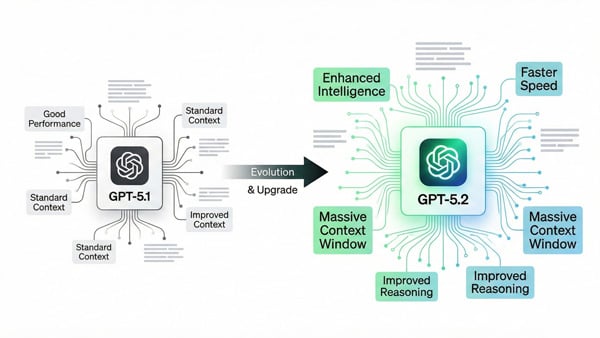
You might be thinking, “It’s only been a few months since 5.1. How much could it have possibly changed?”
The answer is: A lot. This isn’t just a minor patch; it’s a generational leap that justified the “Code Red” status. Here are the five most critical upgrades.
1. “Thinking” Ability Surpasses Human Experts
The biggest headline is the model’s score on GDPval, a metric that measures the ability to perform economically valuable work (like analyzing data or creating professional documents).
The GPT-5.2 Thinking model has officially outperformed human experts with an average of 14 years of experience.
- GPT-5.1: Beat experts only ~38% of the time.
- GPT-5.2: Beat or tied experts 70.9% of the time.
We are moving from an era where humans correct AI drafts to an era where AI produces work equal to—or better than—veteran employees on the first try.
2. A Perfect Score in Math & Coding
STEM capabilities have skyrocketed. In the AIME 2025 mathematics benchmark, GPT-5.2 Thinking achieved a staggering 100% score. Achieving perfection purely through reasoning capabilities—without external tools—is unprecedented.
In coding, it hit a record-high 80% on SWE-bench Verified. Demos have shown the model writing code for complex physics simulations and animations in seconds simply from a natural language prompt like “create a wave simulation”.
3. “Vision” Upgrade: It Sees Details You Miss
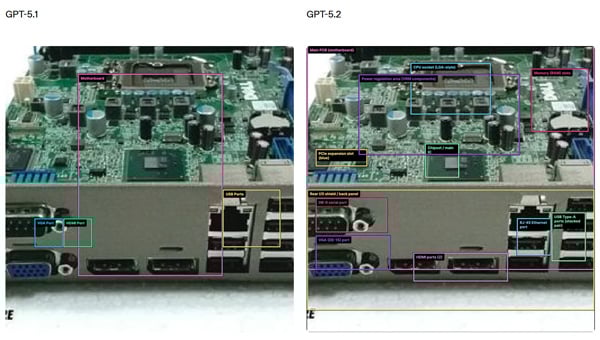
(Source: OpenAI)
The vision capabilities have evolved significantly. In comparisons using low-quality images of computer motherboards, GPT-5.1 could barely spot USB ports. In contrast, GPT-5.2 could identify specific CPU socket types and intricate component layouts even from blurry photos.
This also applies to frontend development; upload a rough hand-drawn sketch, and it can generate the corresponding website code with precise layout fidelity.
4. Massive Context Window (400k Tokens)
The model can now process up to 400,000 tokens at once—equivalent to several full-length books.
Crucially, it’s not just about size; it’s about recall. In “Needle In A Haystack” tests, GPT-5.2 demonstrated nearly 100% accuracy in finding a single piece of specific information hidden within massive datasets. This makes it viable for analyzing extensive legal contracts or corporate manuals.
5. Fewer Hallucinations
The “lying AI” problem is getting solved. Compared to version 5.1, GPT-5.2 has reduced the rate of hallucinations (false information) by approximately 30%. For business use cases, this increased reliability is a major upgrade.
The Showdown: GPT-5.2 vs. Google Gemini 3
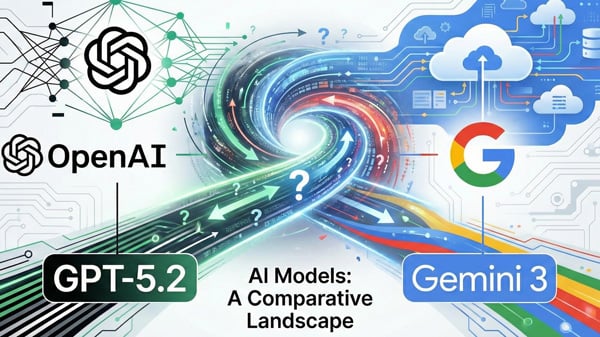
Google’s Gemini 3 has recently held the title of “Best AI,” but the leaderboard has shifted again.
Benchmarks: The King Returns
In head-to-head testing, GPT-5.2 has reclaimed the throne from Gemini 3 Pro and Claude Opus 4.5 across major benchmarks:
- Math (AIME 2025): Gemini 3 Pro (95%) vs. GPT-5.2 (100%)
- Coding (SWE-bench): Claude Opus 4.5 (52%) vs. GPT-5.2 (55%)
- Abstract Reasoning (ARC-AGI 2): Previous Models (~17%) vs. GPT-5.2 (52%)
The massive jump in ARC-AGI (Abstract Reasoning) is particularly telling. It suggests the AI isn’t just memorizing patterns but is actually thinking through novel problems like a human would.
Real-World Usability
Gemini 3 remains a powerhouse, especially if you live in the Google ecosystem (Docs, Gmail). Some users also prefer its speed for simple code generation.
However, for complex instructions, GPT-5.2 pulls ahead. Its “Thinking” process allows it to handle heavy lifts—like writing 1,000 lines of working code for a game in one shot—where competitors might struggle or break the task into frustratingly small chunks.
Verdict: We Are Entering “Emergency” Speeds of Evolution
The fact that OpenAI declared a “Code Red” to release GPT-5.2 highlights the intensity of the AI arms race against Google, Meta, and Anthropic.
For users, this competition is a win. We get access to expert-level AI sooner than expected. While early releases can come with server congestion or minor bugs, the raw capability on display here—100% math scores and expert-level reasoning—signals a shift in how we work. We are no longer just “using” AI; we are beginning to offload actual professional responsibilities to it.
Google will undoubtedly respond soon, but for now, the crown belongs to OpenAI.
Ready to test the evolution yourself? Log in to ChatGPT today and see if GPT-5.2 lives up to the hype.
> The official ChatGPT page is here
OpenAI GPT-5.6 Sol, Terra, and Luna: Complete Pricing, Features, and ChatGPT Work vs. Claude Fable 5 Comparison
Is Chat Dead? Inside OpenAI’s ChatGPT Super App Overhaul & IPO Strategy
What is Cerebras Systems? The Wafer-Scale AI Chip Challenging NVIDIA’s Inference Dominance
GPT-5.5 Explained: Features, Pricing, and How OpenAI’s Autonomous Agent Compares to Claude 4.7
OpenAI GPT-5.4 Released: Autonomous Computer Use, Features, and Gemini vs. Claude Comparison

Why 1.5M Users Canceled ChatGPT: The ‘QuitGPT’ Movement and the Rise of Ethical AI
On the lifestyle web magazine "Minna no Rakuraku Magazine",
we update useful tips and deals every month. Please bookmark us!
- The AI Chip War: Can Google’s TPU Overthrow NVIDIA’s GPU Dominance with a Cost Revolution?
- Is 3I/ATLAS an Alien Spaceship? Separating Viral Rumors from NASA Facts