


OpenAI GPT-5.6 Sol, Terra, and Luna: Complete Pricing, Features, and ChatGPT Work vs. Claude Fable 5 Comparison
[This article may contain PR]

In July 2026, the generative AI landscape experienced another paradigm shift with OpenAI’s official release of the GPT-5.6 model family and its new, business-focused productivity layer, ChatGPT Work. As professionals and enterprises scramble to integrate these advanced cognitive tools, a critical question arises: Does GPT-5.6 finally render competing frontier models obsolete, and how should you deploy its three distinct model tiers to maximize your bottom line?
This comprehensive guide dissects the capabilities, pricing structures, and practical use cases of GPT-5.6 Sol, Terra, and Luna, compares them directly to Anthropic’s Claude Fable 5, and explains how the new ChatGPT Work workspace operates alongside the developer-focused Codex.
Key Takeaways
- Three Specialized Tiers: GPT-5.6 launched on July 9, 2026, introducing Sol (flagship), Terra (balanced daily workhorse), and Luna (ultra-fast, low-cost processing) to match performance requirements directly with budget.
- Unmatched Token Efficiency: GPT-5.6 Sol delivers comparable or superior coding and reasoning capabilities to Claude Fable 5 at roughly one-third to one-half of the API cost.
- Autonomous Agent Orchestration: Powered by Ultra mode and Programmatic Tool Calling, GPT-5.6 can autonomously spin up parallel sub-agents to complete complex, long-horizon tasks like full-stack development and data modeling.
- General Ops vs. Software Dev: OpenAI has consolidated its apps. The new desktop application allows users to seamlessly toggle between ChatGPT Work (designed for business marketing, finance, and document automation) and Codex (built for software engineering and CLI workflows).
- What is the GPT-5.6 Family? Sol, Terra, and Luna Explained
- How to Access GPT-5.6: Plans and Pricing
- GPT-5.6 vs. GPT-5.5 and GPT-4: Next-Level Reasoning and Speed
- GPT-5.6 Sol vs. Claude Fable 5: Which Model is Superior?
- Introducing ChatGPT Work: Your Autonomous Business Chief of Staff
- ChatGPT Work vs. Codex vs. Claude Cowork: Choosing the Right Agent
- Frequently Asked Questions (FAQ)
- Q1: Is GPT-5.6 free to use?
- Q2: What is the difference between ChatGPT Work and Codex?
- Q3: How does Ultra Mode work?
- Q4: Does GPT-5.6 Sol replace Claude Fable 5?
- Conclusion: Embracing the Future of Autonomous AI Work
What is the GPT-5.6 Family? Sol, Terra, and Luna Explained
(Source: OpenAI)
OpenAI’s GPT-5.6 lineup is built around a “celestial” naming convention representing three gradations of intelligence, speed, and cost. By training the models to extract more value from every single token, OpenAI has focused heavily on optimizing enterprise operating costs—a key pain point for businesses running heavy AI workloads.
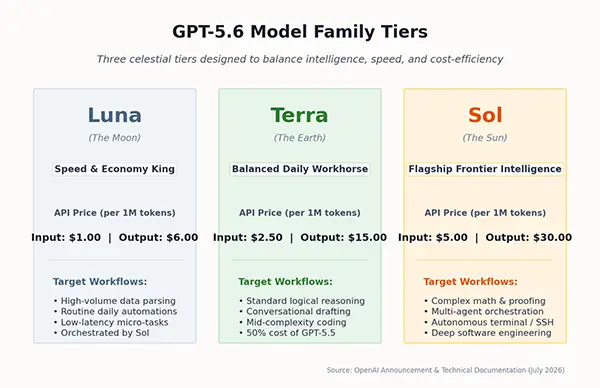
- GPT-5.6 Sol (The Sun): The flagship frontier model designed for highly complex, multi-step reasoning, mathematical proofing, cyber-defense, and heavy coding workflows.
- GPT-5.6 Terra (The Earth): A balanced middle tier that matches the peak intelligence of GPT-5.5 but runs at approximately half the cost and twice the speed.
- GPT-5.6 Luna (The Moon): The fastest and most cost-effective tier, ideal for high-volume data extraction, simple text generation, and orchestration tasks triggered by smarter supervisor agents.
API Pricing Structure (Per 1 Million Tokens)
- Sol: $5.00 Input / $30.00 Output.
- Terra: $2.50 Input / $15.00 Output.
- Luna: $1.00 Input / $6.00 Output.
To understand how OpenAI’s new model family approaches autonomous creation out of the box, watch the official release presentation below.
What You Will Learn From This Video: This official OpenAI demo introduces the GPT-5.6 series, illustrating how the model processes open-ended prompts to design game mechanics, write code, run sandbox test compilations, and output fully functioning applications.
Key Video Highlights & Takeaways:
- Programmatic Tool Calling: GPT-5.6 executes code directly in local sandboxes, bypassing heavy context window exchange loops.
- Tenacious Problem Solving: Shows the model handling structural game designs, composing music, and generating assets completely autonomously.
- Sub-Agent Delegation: The model intelligently spawns parallel helper agents to execute distinct design and logic workflows concurrently.
> Click here for the official ChatGPT website

How to Access GPT-5.6: Plans and Pricing
Access to the new GPT-5.6 models is tier-dependent and scales based on your active subscription plan:
- Free and “Go” Tier Users: Granted default access to the balanced GPT-5.6 Terra model, which is more than capable of handling everyday writing, summarizing, and standard calculations.
- Plus and Business Subscribers: For approximately $20 per month, users can select between Sol, Terra, and Luna, adjusting the reasoning efforts (Medium or High) as needed to conserve their quotas.
- Pro and Enterprise Plans: Priced around $100 per month, these tiers unlock GPT-5.6 Sol Pro and the highly coveted Ultra Mode, which leverages parallel multi-agent configurations to solve long-horizon institutional projects.
> Click here for the ChatGPT pricing page

GPT-5.6 vs. GPT-5.5 and GPT-4: Next-Level Reasoning and Speed
The defining leap from GPT-5.5 to GPT-5.6 is not just raw IQ, but tenacity. Prior models often suffered from “context pollution” or gave up when encountering errors in a multi-step sequence, forcing the user to intervene. GPT-5.6, however, possesses an extraordinary drive to solve problems; it intercepts runtime errors, rewrites its own logic, and iterates until the objective is successfully met.
Comparative Evolution of GPT Models
| Feature / Metric | GPT-4 (Legacy) | GPT-5.5 (Previous Gen) | GPT-5.6 Sol (July 2026 Flagship) |
|---|---|---|---|
| Autonomous Execution | Single-turn prompt-response | Multiple sequential steps | Long-horizon, multi-hour self-correcting loops |
| Orchestration | None | None | Ultra Mode (4 parallel sub-agents) |
| Context Context Window | 32K–128K | 1M | 1M (With improved 350K default active RAM cache) |
| Programmatic Tool Execution | External dependencies | Basic tool calling | Memory-native local CLI and sandbox compilation |
| Efficiency & Speed | Standard | Fast | Up to 1.7x more token-efficient; supports high-speed modes |
For a detailed look at how these efficiency gains translate into real-world software engineering and data pipelines, watch the technical performance review below.
What You Will Learn From This Video: Tech reviewer Theo (t3.gg) analyzes the raw data, benchmark charts, and early testing feedback for GPT-5.6, highlighting its coding agent dominance and token economics.
Key Video Highlights & Takeaways:
- DeepSWE Breakthrough: GPT-5.6 Sol on Max reasoning achieved the highest score ever recorded on the DeepSWE benchmark (73%), completing tasks at under half the cost of Claude Fable 5 ($22 vs. $839 per task).
- Internal R&D Acceleration: OpenAI’s internal researchers doubled their daily output token consumption, managing complex cluster setups and system debugs solely through GPT-5.6.
- Luna as a “Flash” Killer: The low-cost Luna tier outperforms Google Gemini Flash in speed and reliability, making it the perfect engine for background system sweeps.
GPT-5.6 Sol vs. Claude Fable 5: Which Model is Superior?

(Source: Anthropic)
For the past year, Anthropic’s Claude Fable 5 held the crown for advanced creative planning, layout design, and nuanced copywriting. GPT-5.6 Sol has completely closed that gap in core logical tasks, offering a much faster, more affordable daily driver while competing head-to-head on design.
- Left-Brain vs. Right-Brain: In my view, GPT-5.6 Sol acts as a precise, logical engineer (left-brain), whereas Claude Fable 5 remains a highly intuitive, creative architect (right-brain). Fable 5 writes with warmer human empathy, but Sol executes physical browser and local file actions with vastly superior speed and fewer errors.
Head-to-Head: GPT-5.6 Sol vs. Claude Fable 5
| Feature / Metric | GPT-5.6 Sol (OpenAI) | Claude Fable 5 (Anthropic) |
|---|---|---|
| Best For | Browser Automation, Data Science, Speed, Low-Cost Execution | UI/UX Prototyping, Strategy, Creative Writing, Nuanced Editing |
| API Costs (per 1M) | $5.00 Input / $30.00 Output (3x cheaper) | $10.00 Input / $50.00 Output |
| Browser & Computer Use | State-of-the-art; navigates desktop applications natively and accurately | Functional, but significantly slower and consumes heavy token volume |
| Coding Style | Pragmatic, highly functional; prone to writing excess code/tests unless steered | Elegant design layouts, structurally tight, incorporates subtle features |
To see these two giants battle across real-world test cases—ranging from 3D gaming to financial modeling—watch the hands-on comparison video below.
What You Will Learn From This Video: Peter Yang runs head-to-head live trials of GPT-5.6 Sol and Claude Fable 5, testing their front-end design chops, browser control capabilities, and analytical depth.
Key Video Highlights & Takeaways:
- The “Star Fox” Test: While both models built stunning 3D browser games in under 15 minutes, Claude Fable 5 won a slight edge by intuitively programming “barrel rolls” without being prompted.
- The Browser Use Clean Sweep: GPT-5.6 flawlessly executed a 21-step video clipping, captioning, and multi-platform social scheduling workflow using Chrome, whereas Claude struggled with lag and heavy token burn.
- Executive Strategy: Claude Fable 5 provided deeper, highly personalized “blind spot” strategic advice when acting as a business consultant.
Introducing ChatGPT Work: Your Autonomous Business Chief of Staff
(Source: OpenAI)
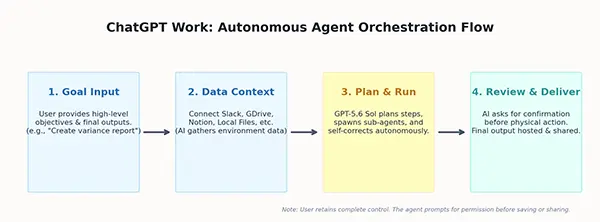
Released alongside the GPT-5.6 family, ChatGPT Work transforms the AI from a text-based chat utility into an active business operator. By securely connecting to your productivity suite (Slack, Google Drive, Microsoft 365, Notion, Calendar), it gathers context, plans execution, and delivers finished, ready-to-share deliverables.
How to Use ChatGPT Work in Your Daily Operations
- Toggle the Workspace Mode: Select the “ChatGPT Work” tab in your web or desktop application.
- Provide High-Level Direction: Enter your objective (e.g., “Analyze this customer survey sheet, extract recurring complaints, and draft tailored email replies for my manual review.”)
- Provide Data Context: Attach local spreadsheets or grant read-access to Google Drive, Notion, or Slack channels.
- Steer and Approve: Work will map out an execution plan and ask for explicit confirmation before taking physical actions (such as saving files to your desktop or queueing drafts in Slack).
- Schedule Automation: Set the task to run on a recurring loop (e.g., “Generate and compile this operational performance brief every Wednesday morning.”)
For a step-by-step walkthrough on setting up your first automated workspace flows, watch the official guide below.
What You Will Learn From This Video: An official OpenAI walkthrough demonstrating how ChatGPT Work links to enterprise databases, translates raw analytics into presentation decks, and publishes custom web dashboards.
Key Video Highlights & Takeaways:
- Zero-Prompt Scheduling: Shows how to designate ChatGPT Work as your “Chief of Staff” to prepare morning agendas and parse calendar conflicts automatically.
- Vibe-to-Dashboard Publishing: Demonstrates a user asking the model to build an interactive onboarding dashboard, editing the visual layout live, and hosting it with a shareable URL in one click.
- Universal Tool Integrations: Watch the agent search local files, track inventory, and debug multi-currency payment forms.
> Click here for the ChatGPT desktop version download page
ChatGPT Work vs. Codex vs. Claude Cowork: Choosing the Right Agent
With different workspace tools hitting the market simultaneously, it can be confusing to know which environment to launch for your specific project. Below is the definitive framework for separating these systems:
- ChatGPT Work: Built for business operators, marketers, and financial analysts. If you need to manage spreadsheets, build PowerPoint decks, summarize Slack channels, or automate email inbox sweeps, this is your environment.
- ChatGPT Codex: Built for software engineers and technical builders. It interfaces with your terminal, manages local development environments, links with GitHub repositories, and handles continuous integration pipelines.
- Claude Cowork (Anthropic): Built for creative directors, content strategists, and deep thinkers. It is unmatched for high-concept brainstorming, drafting long-form essays, and reflecting deeply on ambiguous strategy documents.
> Click here for the ChatGPT desktop version download page
Frequently Asked Questions (FAQ)
Q1: Is GPT-5.6 free to use?
Yes, GPT-5.6 is accessible to free users. Free accounts are assigned GPT-5.6 Terra, which handles standard knowledge tasks and simple coding with excellent speed. Premium tiers (such as Plus, Pro, and Enterprise) are required to access the flagship Sol model and parallel Ultra sub-agent processing.
Q2: What is the difference between ChatGPT Work and Codex?
While both run on the GPT-5.6 engine, they serve entirely different roles. ChatGPT Work is tailored for general office operations, utilizing direct connections to spreadsheets, slide decks, and team channels. Codex is an engineering sandbox that runs terminal commands, reads local system directories, and compiles development builds natively.
Q3: How does Ultra Mode work?
Ultra Mode is a reasoning effort setting available to paid plans. When activated, the primary GPT-5.6 Sol model does not work alone; instead, it automatically spawns four parallel sub-agents. These agents divide the project (e.g., separating database architecture, front-end design, and system testing) to finish massive projects in a fraction of the time.
Q4: Does GPT-5.6 Sol replace Claude Fable 5?
Not entirely. GPT-5.6 Sol is the clear winner for speed, API cost-efficiency (saving ~60%), and automated browser interactions. However, Claude Fable 5 remains highly competitive for sophisticated copywriting, natural human conversations, and complex UI designs that require a polished “creative touch”.
Conclusion: Embracing the Future of Autonomous AI Work
The release of GPT-5.6 and ChatGPT Work signals a profound transition from consultative AI (answering questions) to delegated AI (completing physical work). We are no longer limited to using AI as a sounding board; we can now manage it as a highly capable, self-correcting team of digital specialists.
Whether you start by automating small daily email administrative tasks on the free Terra tier or deploying Sol Pro’s Ultra Mode to build end-to-end custom software pipelines, the competitive advantage belongs to those who learn to steer these agents effectively. Stop chatting, and start delegating.
> Click here for the official ChatGPT website
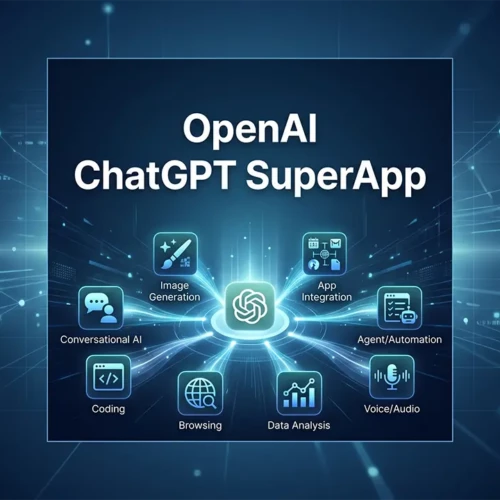
Is Chat Dead? Inside OpenAI’s ChatGPT Super App Overhaul & IPO Strategy

What is Cerebras Systems? The Wafer-Scale AI Chip Challenging NVIDIA’s Inference Dominance
GPT-5.5 Explained: Features, Pricing, and How OpenAI’s Autonomous Agent Compares to Claude 4.7
OpenAI GPT-5.4 Released: Autonomous Computer Use, Features, and Gemini vs. Claude Comparison

Why 1.5M Users Canceled ChatGPT: The ‘QuitGPT’ Movement and the Rise of Ethical AI
ChatGPT’s “Code Red” Update: GPT-5.2 Release Date, Pricing, and Gemini 3 Comparison
On the lifestyle web magazine "Minna no Rakuraku Magazine",
we update useful tips and deals every month. Please bookmark us!
- Palworld 1.0 Release Guide: Exact Launch Time, 40+ New Pals, and Essential Save Data Tips
- Google Drops Gemini 3.6 Flash: High-Speed Agentic AI Beats Claude and GPT in PC Control (July 2026)