


Google Drops Gemini 3.6 Flash: High-Speed Agentic AI Beats Claude and GPT in PC Control (July 2026)
[This article may contain PR]

In the rapidly evolving landscape of generative artificial intelligence, developers and business leaders are constantly searching for ways to achieve faster processing speeds, slash API operational costs, and deploy autonomous agents capable of handling complex, multi-step workflows.
On July 21, 2026, Google answered these demands by launching Gemini 3.6 Flash, alongside two specialized sibling models: Gemini 3.5 Flash-Lite and Gemini 3.5 Flash Cyber. Far from a minor incremental update, this release marks a decisive transition into the era of “Agentic AI”—where models are optimized not just to think and generate text, but to actively navigate, manipulate, and control computer interfaces at a fraction of previous costs.
Key Takeaways
- Massive Cost and Token Efficiency: Gemini 3.6 Flash delivers a 17% average reduction in output token usage (and up to 65% in specialized coding tasks), meaning actual operational costs are significantly lower than nominal price drops.
- Built-In Computer Use: The model natively integrates “Computer Use” capabilities, allowing AI agents to interpret screens, simulate mouse clicks, and trigger keyboard inputs to automate multi-step desktop and browser tasks.
- Unmatched Context & PC Control: Gemini 3.6 Flash dominates rivals in long-document processing (91.8% accuracy at 128k context) and desktop automation (83.0% on OSWorld), outperforming GPT-5.6 Luna and Claude Sonnet 5 in these domains.
- Selective Coding Performance: While exceptional at RPA-style automation, the model still trails behind GPT-5.6 Luna and Claude Sonnet 5 in highly complex, multi-step software engineering benchmarks.
- Stepping Stone to Gemini 4.0: This release serves as a crucial testing ground for Google’s next-generation flagship, Gemini 4.0, which has officially entered pre-training with massive infrastructure backing.
Related Post

- What is Gemini 3.6 Flash? (July 2026 Announcement)
- Hands-on Performance & Real-World Coding Tests
- Pricing Comparison & How to Access Gemini 3.6 Flash
- Gemini 3.6 Flash vs. GPT-5.6 Luna vs. Claude Sonnet 5: Strengths and Weaknesses
- Benchmark Comparison Table
- Analyzing the Strengths and Weaknesses
- The Smart Routing Strategy: Which Model to Use?
- The Road to Gemini 4.0: What Happened to Gemini 3.5 Pro?
- FAQ: Frequently Asked Questions about Gemini 3.6 Flash
- Q1: Is Gemini 3.6 Flash free to use?
- Q2: How does Gemini 3.6 Flash reduce output costs?
- Q3: What is "Computer Use" and how do I access it?
- Q4: When will Gemini 4.0 be released?
- Conclusion: Step-by-Step Optimization for the AI Era
What is Gemini 3.6 Flash? (July 2026 Announcement)
(Source: Google)
The Gemini 3.6 Flash model is Google’s new mid-tier flagship, specifically engineered to build and run large-scale agentic workflows with low latency and high reliability.
In this July 2026 drop, Google expanded its efficient model lineup with three distinct variants, each designed for specific deployment scenarios:
- Gemini 3.6 Flash (The Workhorse): Upgraded with superior coding, knowledge work, and multimodal capabilities. It features a massive 1-million-token context window and a 64k-token output limit, allowing it to process massive code repositories or multi-hour datasets in a single turn.
- Gemini 3.5 Flash-Lite (The Speed Demon): The fastest and most economical model in the 3.5 lineup. Clocking in at an incredible 350 output tokens per second, it is ideal for high-volume data categorization, real-time search agents, and high-frequency routing.
- Gemini 3.5 Flash Cyber (The Security Specialist): Fine-tuned exclusively to find, validate, and patch software vulnerabilities in Google’s CodeMender platform. Scoring an impressive 83.2% on the Cyber Gym benchmark—putting it on par with elite frontier security agents—it is restricted to government agencies and trusted security partners to prevent potential exploitation.
The Agentic Shift: Introducing Native “Computer Use”
The most significant architectural upgrade in Gemini 3.6 Flash is the native integration of Computer Use directly into the Gemini API and Gemini Enterprise.
Rather than relying on clunky third-party wrapper tools, the model can now natively “see” a virtual operating system, interpret pixel layouts, and execute precise cursor clicks and keyboard strokes. This turns the AI from a conversational advisor into an active operator capable of executing administrative, database, and browser-based tasks on behalf of the user.
Hands-on Performance & Real-World Coding Tests
To understand how these upgrades translate into practical workflows, developers have been stress-testing Gemini 3.6 Flash’s coding and multimodal capabilities. The following video demonstrates how the model performs on highly complex real-world tasks.
Key Insights from the Testing Video:
- Dynamic 3D Generation: In the 3D-printable V8 engine model test, Gemini 3.6 Flash went above and beyond by building a complete interactive 3D preview web interface. It featured exploded and assembly views, toggleable components (such as a 280 DC motor preview), and individual STL file download buttons—a presentation that surpassed anything previously seen with other LLMs.
- Zero-Bug Android App Installation: When tasked with building an exotic guitar tuner Android application, the model successfully connected via Android Debug Bridge (ADB), compiled, and installed the app onto a physical Android smartphone without a single error. The app natively utilized the phone’s microphone, processed audio DSP in real-time, and included advanced features like an AI-generated custom tuning system based on musical genres.
- Responsive Visual Iteration: In C++ skateboard simulator and synth-grid OS tests, the model proved highly responsive to visual feedback. Providing the model with a screenshot of a UI bug allowed it to immediately pinpoint the issue (such as Tailwind CSS overflow) and correct it in the next execution turn.
Pricing Comparison & How to Access Gemini 3.6 Flash
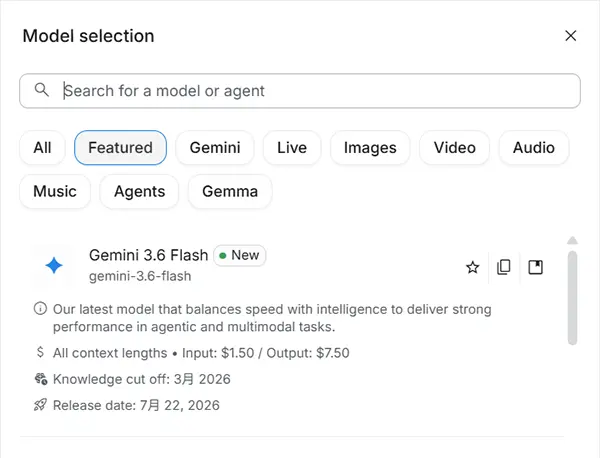
Gemini 3.6 Flash is widely accessible to developers, enterprises, and general users starting today:
- For Developers: Instantly available in Google AI Studio and Google Antigravity. Developers can select the model from the dropdown and generate API keys for application integration.
- For Enterprises: Integrated natively into the Gemini Enterprise Agent Platform and Gemini Enterprise app.
- For General Users: Rolling out as the backend intelligence layer for the standard Google Gemini App (Web, iOS, and Android), with several core features available on the free tier.
API Pricing Structure (Per Million Tokens)
Google has adjusted its API pricing to lower entry barriers, establishing a significant competitive edge over rival lightweight models.
| Model Name | Input Price (Per 1M Tokens) | Output Price (Per 1M Tokens) | Target Use Case & Core Focus |
|---|---|---|---|
| Gemini 3.6 Flash | $1.50 | $7.50 | Flagship agentic workflows, RAG, and complex coding |
| Gemini 3.5 Flash | $1.50 | $9.00 | (Legacy Model) |
| Gemini 3.5 Flash-Lite | $0.30 | $2.50 | Ultra-high-speed routing, parsing massive datasets, routine tasks |
The “Hidden” Token Discount
While a $1.50 reduction in output pricing is welcome, the true financial advantage lies in token efficiency. Because Gemini 3.6 Flash requires fewer reasoning and output steps, it consumes up to 17% fewer output tokens on average compared to the 3.5 version for identical tasks.
In specialized software engineering tests, output token consumption plummeted by up to 65%. This means your actual invoice will reflect a much deeper discount than the nominal price-per-million price cut.
At $0.30 input and $2.50 output, Gemini 3.5 Flash-Lite represents a massive pricing breakthrough. This cost structure makes it financially viable to automate high-volume enterprise operations that were previously cost-prohibitive, such as processing tens of thousands of corporate receipts, automating high-frequency email sorting, or serving as a high-speed routing agent.
Gemini 3.6 Flash vs. GPT-5.6 Luna vs. Claude Sonnet 5: Strengths and Weaknesses
(Source: OpenAI)
With OpenAI’s GPT-5.6 Luna and Anthropic’s Claude Sonnet 5 competing in the mid-tier market, choosing the right model is critical.
The latest official benchmarks published by Google offer a highly transparent look at how Gemini 3.6 Flash stacks up against its core rivals:
Benchmark Comparison Table
| Benchmark (Measuring Domain) | Gemini 3.6 Flash | GPT-5.6 Luna | Claude Sonnet 5 |
|---|---|---|---|
| OSWorld-Verified (PC Control / RPA) | 83.0% | 72.6% | 81.2% |
| GDM-MRCR v2 128k (Long-Context Reasoning) | 91.8% | 74.8% | 71.6% |
| SWE-Bench Pro (Autonomous Software Engineering) | 58.7% | 62.7% | 63.2% |
| DeepSWE v1.1 (Multi-File / Long-Term Development) | 49.0% | 67.0% | 54.0% |
| MLE-Bench (Machine Learning Engineering) | 63.9% | 47.6% | 66.9% |
Analyzing the Strengths and Weaknesses
The objective data clearly highlights where Gemini 3.6 Flash shines and where it falls short:
- Where Gemini Dominates:
- Browser & OS Automation (83.0%): Gemini’s ability to interpret interfaces and simulate actions is elite, beating Claude Sonnet 5 and easily outperforming GPT-5.6 Luna.
- Long-Context Information Retrieval (91.8%): When processing long documents (128k to 1M tokens), Gemini maintains near-perfect accuracy, retrieving needles in massive data haystacks where competitors fail to scale.
- Where Gemini Falls Behind:
- Advanced Software Engineering: On benchmarks like SWE-Bench Pro (58.7%) and DeepSWE (49.0%), Gemini 3.6 Flash lands in last place, lagging behind GPT-5.6 Luna’s robust multi-file development capabilities and Claude Sonnet 5’s elite coding logic.
The Smart Routing Strategy: Which Model to Use?
Based on these characteristics, developers should implement a smart routing strategy:
- Choose Gemini 3.6 Flash for: Multi-hundred-page contract and manual analysis, RPA-style screen automation, visual chart parsing, and high-speed data extraction.
- Choose GPT-5.6 Luna for: Highly complex, multi-file software engineering tasks and long-term codebase debugging.
- Choose Claude Sonnet 5 for: Advanced academic research, hyper-creative and localized content generation, and fine-tuning machine learning models.

The Road to Gemini 4.0: What Happened to Gemini 3.5 Pro?
The release of Gemini 3.6 Flash surprised many in the AI community who were eagerly awaiting the launch of Gemini 3.5 Pro.
Google confirmed that Gemini 3.5 Pro is currently undergoing private testing with enterprise partners and will be released broadly as soon as it meets quality standards. However, industry insiders suggest Google’s focus has already shifted to a much larger milestone.
While Gemini 3.6 Flash acts as the immediate workhorse, Google has officially commenced pre-training for its true next-generation frontier model: Gemini 4.0.
To understand Google’s broader strategic vision and the massive shifts expected in the AI landscape, the following comprehensive video analyzes the upcoming Gemini 4.0 ecosystem and the groundbreaking announcements anticipated for Google I/O 2026.
Key Predictions and Highlights from the Video:
- Paradigm Shift to Autonomous Teammates: Gemini 4.0 transitions AI from a reactive assistant to an active teammate. It is expected to process over 2 million context tokens and feature persistent, cross-session memory to autonomously manage long-term workflows.
- Veo 4 & Next-Gen Media: Alongside Gemini 4.0, Google is preparing Veo 4, a revolutionary video generation model capable of producing 10 to 30-second clips, storyboarding, and full 4K rendering.
- Aluminium OS & Physical Integration: Google is reportedly planning Aluminium OS, a desktop Android platform with deep system-level Gemini integration, alongside smart glasses (in partnership with Samsung) that run hands-free AI assistants.
- Massive Hardware Backing: To power this ecosystem, Google is scaling its new Ironwood TPU infrastructure. A single pod of 9,216 chips is estimated to deliver a massive 42.5 exoflops of computing power, signaling Google’s commitment to dominating the next phase of the AI race.
Google is backing this vision with unprecedented infrastructure investments, scale-buying Broadcom TPU processors, and setting up massive data centers designed to deliver over 42 exoflops of computing power.
FAQ: Frequently Asked Questions about Gemini 3.6 Flash
Q1: Is Gemini 3.6 Flash free to use?
Yes, general users can access Gemini 3.6 Flash for everyday tasks via the web or the official Google Gemini app on Android and iOS for free. Developers can also test the model for free within Google AI Studio within certain rate limits.
Q2: How does Gemini 3.6 Flash reduce output costs?
Beyond a direct $1.50 price cut per million tokens on API output, the model’s architecture is highly optimized, requiring 17% fewer output tokens on average to complete identical tasks. In coding tasks, the token consumption is reduced by up to 65%.
Q3: What is “Computer Use” and how do I access it?
“Computer Use” is an advanced feature that allows Gemini to interpret visual interfaces, move virtual cursors, and type inputs to complete desktop tasks. It is natively available as an API tool in Google AI Studio and is integrated into Gemini Enterprise.
Q4: When will Gemini 4.0 be released?
While Google has not officially confirmed a launch date, they have formally announced that pre-training for Gemini 4.0 has begun. Based on historical release cycles and infrastructure timelines, analysts expect a preview or demo of Gemini 4.0 in late 2026, with a wider rollout extending into early 2027.
Conclusion: Step-by-Step Optimization for the AI Era
The arrival of Gemini 3.6 Flash has successfully commoditized high-speed, cost-effective agentic workflows. By reducing token consumption, dropping prices, and opening up native computer control, Google has shifted the competitive focus from raw model intelligence to practical, cost-efficient, real-world utility.
Instead of remaining a passive observer, the best way to leverage this technology is to start building. We highly recommend visiting Google AI Studio, selecting Gemini 3.6 Flash, and testing your company’s heavy data-parsing or document-summarization tasks. Once you experience the raw speed and cost efficiency firsthand, you will immediately see how to optimize your business operations for the agentic era.
Gemini 3.8 Flash Pricing: Why a Flat Token Rate Means a 40% Higher Bill
Is Twitter Really Back? The Legal and Technical Reality Behind Twitter.now (August 2026)
Grok 4.6 Ultimate Guide: Pricing, Benchmarks, and Top Features (August 2026)
OpenAI GPT-5.6 Sol, Terra, and Luna: Complete Pricing, Features, and ChatGPT Work vs. Claude Fable 5 Comparison
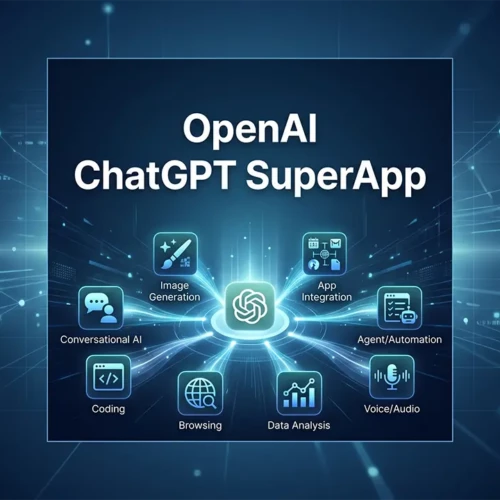
Is Chat Dead? Inside OpenAI’s ChatGPT Super App Overhaul & IPO Strategy
GPT-5.5 Explained: Features, Pricing, and How OpenAI’s Autonomous Agent Compares to Claude 4.7
On the lifestyle web magazine "Minna no Rakuraku Magazine",
we update useful tips and deals every month. Please bookmark us!
- OpenAI GPT-5.6 Sol, Terra, and Luna: Complete Pricing, Features, and ChatGPT Work vs. Claude Fable 5 Comparison
- Nintendo's Palworld Patents Rejected in the US and Japan: 2026 Lawsuit Updates